
In RAID 1+0, or RAID 10, the drives in the array is mirrored first (RAID 1) and then striped (RAID 0). This provides a better fault tolerance than RAID (0+1). At least 4 drives is needed.
GRAPHIC OF RAID 10
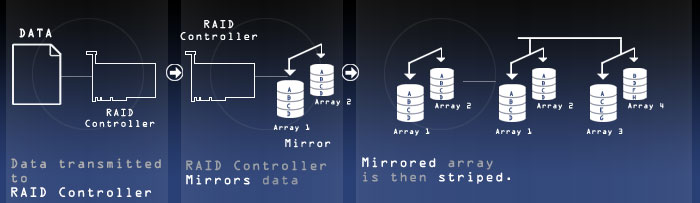
1) Data is first transmitted to RAID controller
2) Then, the data is written to “array 1” and is then mirrored to “array 2”
3) Then, “array 1” and “array 2” is striped onto “array 3” and “array 4”
RAID 10 can survive multiple drive failure, as long as the drive failure is in different sets.
The disadvantage here is storage capacity is halved, due to mirroring.
Data recovery Salon welcomes your comments and share with us your ideas, suggestions and experience. Data recovery salon is dedicated in sharing the most useful data recovery information with our users and only if you are good at data recovery or related knowledge, please kindly drop us an email and we will publish your article here. We need to make data recovery Salon to be the most professional and free data recovery E-book online.