 Subscribe by RSS
Vocabulary F-J
F
FAT
See File Allocation Table.
FAT32
See File Allocation Table.
FDISK
The disk-partitioning program used in DOS and several other operating systems to create the master boot record and allocate partitions for the operating system’s use.
File
A collection of data grouped into one unit on a disk.
File Allocation Table
(FAT or FAT32) DOS uses the FAT to manage the disk data area. The FAT tells DOS which portions of the disk belong to each file. The FAT links together all of the clusters belonging to each file, no matter where they are on disk. The FAT is a critical file: you should be sure to back it up regularly.
FAT32 is a newer type of FAT that was designed to handle large hard disks. The older FAT (FAT16) can only support partitions up to two gigabytes in size. FAT32 can handle partitions that are thousands of gigabytes.
File System
A system for organizing directories and files, generally in terms of how it is implemented in the disk operating system.
Firmware
Software contained in a read-only memory (ROM) device.
Folder
Commonly used as a standard Windows 95/98/NT term, equivalent to the Windows 3.x term directory.
FORMAT
The DOS format program that performs high-level formatting on a hard disk, and both high- and low-level formatting on a floppy disk.
Fragmentation
The state of having a file scattered around a disk in pieces rather than existing in one contiguous area of the disk. Fragmented files are slower to read than unfragmented files.
G
Graphics Adapter
See Video Adapter
H
Head
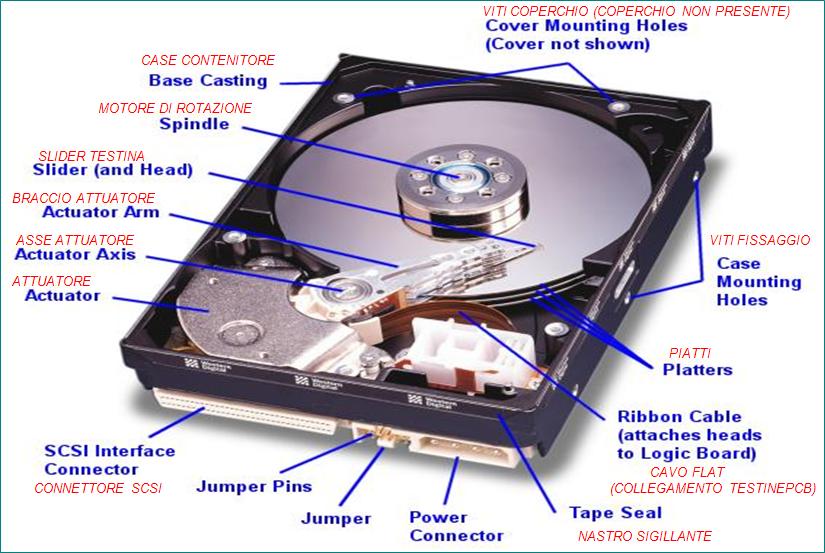
A small electromagnetic device inside a drive that reads, writes, and erases data on the drive’s media.
History
(Internet Browser) – Stores the internet addresses (URLs) of the web sites you have visited.
Heat Sink
A mass of metal attached to a chip carrier or socket for the purpose of dissipating heat.
HDA
HDA is the acronym of Hard Disk Assembly. It is the mechanical part of a fixed hard drive and is typically a sealed unit. HAD includes disks, spindal motor, voice coil actuator, read/write heads, platters, air filter etc. it is a mechanical component minus the electronics. In other words, Hard Disk Assembly is an airtight assembly including a disk pack and read/write heads.
I
IDE
Stands for integrated drive electronics. Describes a hard disk with the disk controller integrated within it. See also EIDE.
I/O Port
I/O stands for input/output. I/O is the communication between a computer and its user, its storage devices, other computers (via a network) or the outside world. The I/O port is the logical channel or channel endpoint in an I/O communication system.
IRQ
Stands for interrupt request. IRQ is the name of the hardware interrupt signals that PC peripherals (such as serial or parallel ports) use to get the processor’s attention. Since interrupts usually cannot be shared, devices are assigned unique IRQ addresses that enable them to communicate with the processor. Peripherals that use interrupts include LAN adapters, sound boards, scanner interfaces, and SCSI adapters.
J
Jumper
A small, plastic-covered metal clip that slips over two pins protruding from a circuit board. When in place, the jumper connects the pins electronically and closes the circuit, turning it “on”.
World’s Top Data Recovery Hardware Tools
Easy to use at good price
Recover SATA, IDE, External HDDs, NVME SSDs, etc Order Now here
POTABLE DEVICE & NVME SSD RECOVERY TOOL
Recover USB Device and NVME SSDs at high speed! Read Details here.
DFL-PCIE DATA RECOVERY RECHARGE
Best data recovery hardware tool to start a data recovery business, read details here
RECOVER SCRATCHED HDDS

Recover lost data from scratched hard drives, read details here.
SURFACE PRO. RECOVERY
BEST HEAD REPLACEMENT TOOLS
The most cost-effective head replacement tools for Seagate, WD, Samsung, Hitachi, Toshiba, Fujitsu