 Subscribe by RSS
5.25″ Form Factor Of Hard Disk Drive
The 5.25″ form factor is the oldest in the PC world. Used for the first hard disks on the original IBM PC/XT back in the early 1980s, this form factor has been used for most of the PC’s life span, but is now obsolete. The basis of the form factor is the 5.25″ drive bay used in the first PCs for 5.25″ floppy disk drives (themselves obsolete today). These bays still exist today in modern PCs, but are now used primarily for CD-ROM/DVD drives and similar devices, not hard disks. The 5.25″ form factor was replaced by the 3.5″ form factor for two main reason: first, 5.25″ drives are big and take up a lot of space; second, 3.5″ drives offer better performance; see the discussion in the section on platter sizes for an explanation. The use of 5.25″ drives continued as late as the mid-1990s for high-end drives used in servers and other applications where the large size of the platters in these drive was needed to allow drives with high capacities to be created. They mostly disappeared from consumer PC many years prior to that.
5.25″ drives generally use 5.12″ platters and have a width of 5.75″ and depth of 8.0″. For many years they were found in only two different height profiles: full-height, meaning the same height as the floppy drive on the original PC and the bay it used (3.25″); and half-height, which is of course half that number. In the 1990s, Quantum launched a new line of 5.25″ drives named the Bigfoot family, which reintroduced 5.25″ drives to the consumer marketplace. These were sold as “economy” drives and due to the larger platter size, offered a lot of capacity–but due to slower spindle speeds and a “value line” design, not much performance. They were popular with many PC manufacturers but eventually were phased out. These drives used what had up to that point been non-standard heights for 5.25″ drives, typically 1″ high or less. Quantum calls these drives low-profile or ultra-low-profile. Here are the statistics and applications of the different profiles used in the 5.25″ form factor:
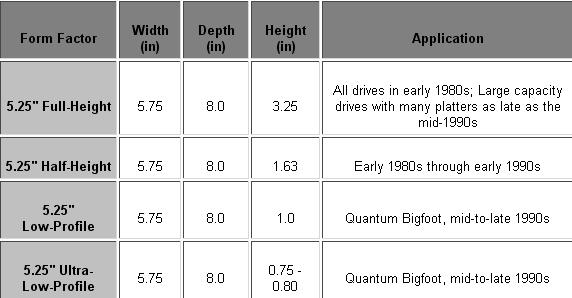
Interestingly, despite the general trend to smaller drives, the drives that continued to use the 5.25″ form factor through the late 1980s and early 1990s were more often found as full-height devices than half-height ones. This may be due to the fact that their niche became applications where a lot of storage was needed, so the ability to fit many more platters in that nice, roomy 3.25″ high package was attractive.
Data recovery Salon welcomes your comments and share with us your ideas, suggestions and experience. Data recovery salon is dedicated in sharing the most useful data recovery information with our users and only if you are good at data recovery or related knowledge, please kindly drop us an email and we will publish your article here. We need to make data recovery Salon to be the most professional and free data recovery E-book online
World’s Top Data Recovery Hardware Tools
Easy to use at good price
Recover SATA, IDE, External HDDs, NVME SSDs, etc Order Now here
POTABLE DEVICE & NVME SSD RECOVERY TOOL
Recover USB Device and NVME SSDs at high speed! Read Details here.
DFL-PCIE DATA RECOVERY RECHARGE
Best data recovery hardware tool to start a data recovery business, read details here
RECOVER SCRATCHED HDDS

Recover lost data from scratched hard drives, read details here.
SURFACE PRO. RECOVERY
BEST HEAD REPLACEMENT TOOLS

The most cost-effective head replacement tools for Seagate, WD, Samsung, Hitachi, Toshiba, Fujitsu